
Looking Beneath the Academic Difficulty
You’ve explained it again.
You’ve provided another example.
You’ve given the student more time, more practice, and extra support.
And yet, the same difficulty keeps appearing.
For educators -teachers, tutors, educational assistants, resource teachers, and homeschool parents- this can be one of the most frustrating parts of supporting a struggling learner.
Why does a student continue to struggle even after good instruction and repeated practice?
Sometimes the answer is straightforward: the student hasn’t yet mastered the skill and needs more explicit instruction and practice. But sometimes the academic difficulty we see is only the most visible part of the problem.
Reading, writing, and math rely on many processes working together. Attention, memory, language processing, executive functioning, and self-monitoring can all influence how efficiently a student learns.
When progress remains limited despite appropriate instruction and support, it may be time to look beneath the academic struggle.

Academic Difficulties Can Be Clues
When a student struggles with reading, our natural response is to work on reading. When writing is difficult, we work on writing. When math facts don’t stick, we practise math facts. Those responses may be exactly what the student needs.
But what happens when they aren’t enough?
Perhaps a student appears to understand a concept during instruction but has difficulty retrieving it later. Or maybe a learner has wonderful ideas when speaking but struggles to communicate those same ideas in writing. Those inconsistencies can be frustrating—but they can also be clues.
Instead of only asking: “What academic skill does this student need to practise?” we can also ask: “What might be getting in the way of this student learning efficiently?”
That shift—from focusing only on performance to becoming curious about the learning process—can change what we notice.
Learning requires More Than Academic Knowledge. What the Research Says.
A seemingly simple academic task can place many demands on a learner at once.
Students may need to focus their attention, hold information in mind, retrieve previous learning, organize their thinking, monitor their progress, and change strategies when something isn’t working.
Research supports the importance of these underlying processes.
The Center on the Developing Child at Harvard University identifies
working memory, mental flexibility, and self-control as core executive-function skills. Together, these skills help children work with information, maintain focus, manage distractions, and adjust their thinking as demands change.
Research has also found meaningful connections between executive functioning and academic learning. A large meta-analysis involving more than
64,000 elementary-school-age children found significant relationships between executive-function skills and outcomes in reading, mathematics, and oral language.
In other words, academic performance isn’t only about what a student knows. How a student manages and works with information matters too.
When Should We Look Deeper?
Every learner forgets.
Every learner becomes distracted.
Every learner occasionally needs extra explanation or practice.
One difficult assignment—or even one difficult week—doesn’t tell us very much. What deserves our attention is a pattern.
Is the student receiving appropriate instruction but making less progress than expected?
Are difficulties appearing repeatedly across different tasks or settings?
Is the learner requiring considerably more effort or adult support than expected?
Does something about the student's performance consistently leave you thinking:
“They know more than they’re able to show me”?
These patterns don’t give us an immediate explanation or diagnosis. But they do give us a reason to become curious. And curiosity is an important starting point for effective intervention.
Look at the Learner, Not Just the Work
When a student gives an incorrect answer, it’s easy for our attention to go straight to the mistake.
Correct it. Reteach it. Practise it. Try again.
But the incorrect answer is only one piece of information. We can also pay attention to how the student approaches learning.
What happens when the learner encounters something unfamiliar?
What do they do when their first attempt doesn’t work?
Do they recognize when they’ve made an error?
Do they have strategies for getting unstuck?
Observations like these help us see the learner behind the academic performance.

From Helping Students to Developing Learners
When students struggle, caring adults naturally want to help. We repeat instructions. Give hints. Remind them of the next step.
Sometimes that’s exactly what is needed.
But our long-term goal isn’t simply to help a student successfully complete today’s assignment. We want students to become increasingly capable of approaching difficult learning themselves. We want them to plan, problem-solve, recognize errors, adjust strategies, persevere, and think about their own thinking.
In other words, we want to develop active, independent learners. This is an important goal of NILD Educational Therapy®. NILD Educational Therapy® is an individualized, language-based intervention that seeks to strengthen areas of
difficulty rather than simply addressing the academic symptoms we can see. NILD educational therapists work with both academic skills and the cognitive and perceptual processes involved in learning.
The aim isn’t greater dependence on an adult. It’s greater independence.
What Can You Do When a Student Continues to Struggle?
You don’t need to have an immediate answer. Start by noticing. Rather than responding to each difficulty as an isolated problem, begin looking for patterns.
What types of tasks consistently cause difficulty?
When does the student seem most successful?
What changes when the work becomes more demanding?
What kind of support seems to help?
Over time, those observations can help move us from: “This student is struggling.” to: “I’m beginning to understand this learner more clearly.”
And that’s a much stronger starting point for deciding what kind of support may be needed.
Free Guide: What’s Underneath the Struggle?
Knowing that you should “look deeper” is one thing. Knowing what to look for is another. That’s why NILD Canada created the free guide:
What’s Underneath the Struggle?
10 Signs a Student May Need Deeper Intervention
This practical resource helps teachers, tutors, educational assistants, resource teachers, and homeschool parents recognize patterns that may indicate a learner needs more than additional practice.
It includes practical observation tools, questions that encourage independent thinking, and ideas for tracking patterns over time.
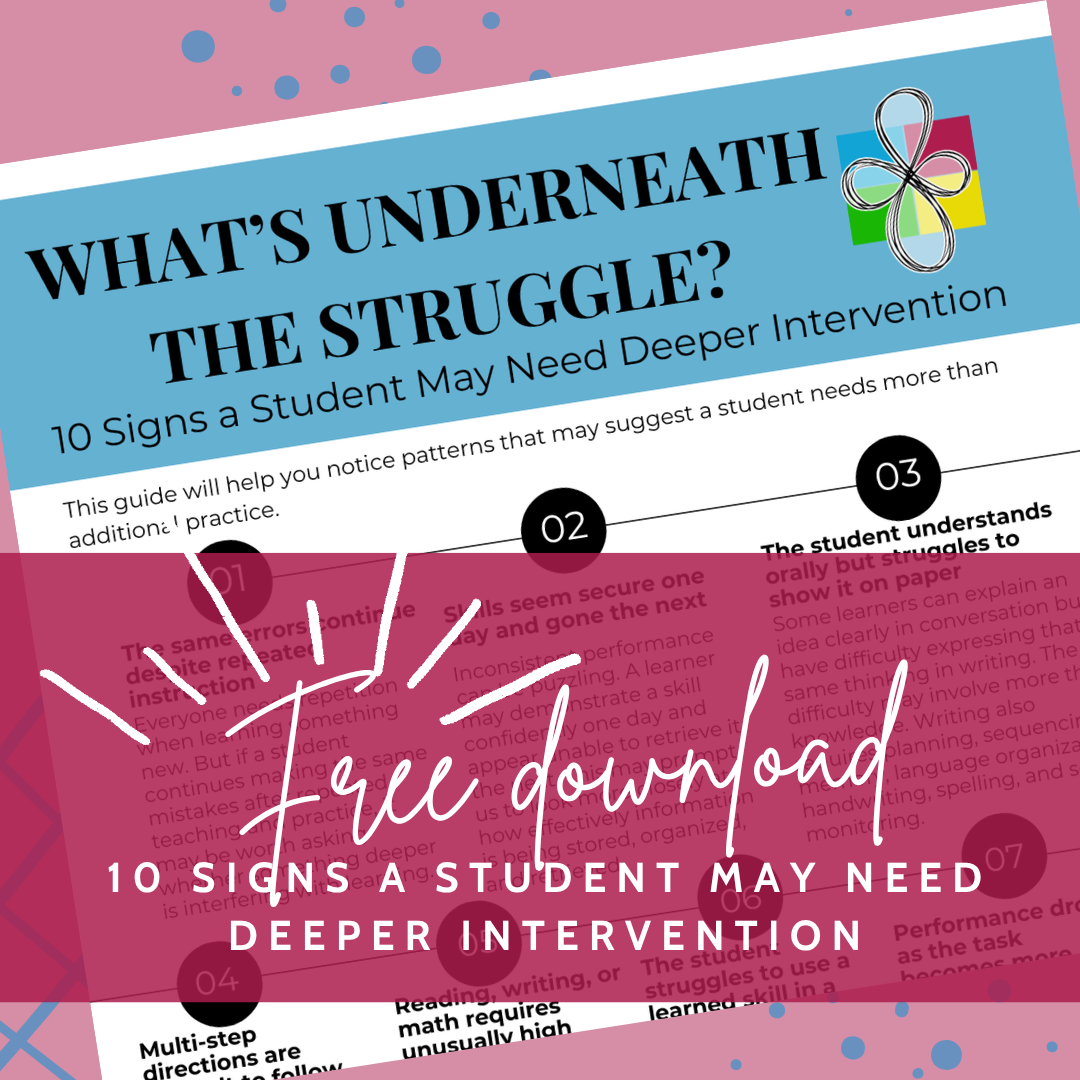
Use it as you get to know your students this year – or with a learner who has already left you wondering: “What am I missing?”
Want to Learn How to Go Deeper?
Recognizing that something is getting in the way of learning is only the beginning. The next question is: How can we intentionally help the learner move forward?
NILD Canada’s Level 1 Educational Therapy Training equips educators with a deeper understanding of struggling learners and provides practical techniques for individualized intervention.
Level 1 is the first step in NILD Canada’s Educational Therapy training and prepares participants to identify student learning needs and develop individualized Educational Therapy plans.

Learn More
The next time a learner continues to struggle despite good teaching and support, resist the temptation to immediately conclude that they aren’t trying hard enough—or that they simply need more practice.
Instead, become curious.
The academic difficulty may be telling you something.
Ask: “What is this student showing me about how they learn?” Because when we begin looking beneath the struggle, we may begin to see a different path forward.
Research & Further Reading
Center on the Developing Child at Harvard University. A Guide to Executive Function. Executive function skills help us plan, focus attention, switch gears, and juggle tasks. Learn how to enhance and develop these core skills for lifelong health and well-being.
Spiegel, J. A., et al. Relations between Executive Functions and Academic Outcomes in Elementary School Children: A Meta-Analysis. Psychological Bulletin, 2021. Analysis of 305 studies involving more than 64,000 elementary-school-age children examining relationships between executive functions and reading, mathematics, and language.
NILD Canada. NILD Educational Therapy. Learn more about the individualized approach to strengthening cognitive, perceptual, and academic skills.